
Banks that stop moving
Slope & Erosion Control in Providence, RI
Blankets, hydromulch and bonded fiber on the short, steep banks this hilly city is full of.
- No-charge site visit, then an itemized quote in writing
- Seed mix picked for the sun, shade and slope on your lot
- A printed aftercare sheet: when to water and when to mow for the first time
Holding Soil on a City of Hills
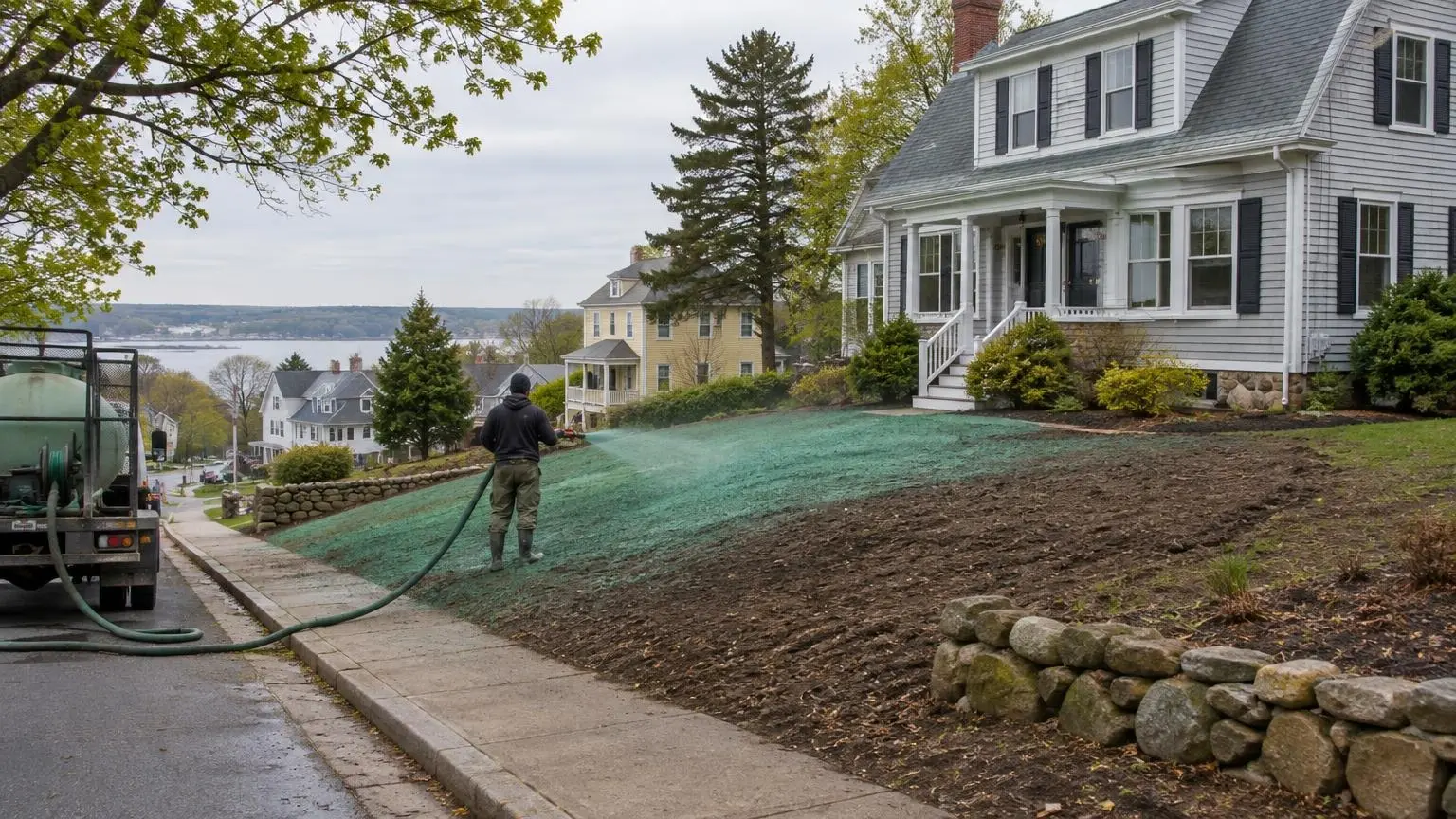
Slope and erosion control in Providence starts with the shape of the place. The city is one of many said to be founded on seven hills, and the land around it rises from the bay into glacial ridges. That leaves homeowners and builders with short banks above sidewalks, terraced backyards, roadside cuts and drainage swales that carry water every time it storms. Bare soil on any of them washes downhill. As erosion control contractors, we cover the slope with something that holds until grass roots can take over.
Why slopes fail here
The glacial soils of Rhode Island's uplands, like the Narragansett series, have a silt loam surface over gravelly coarse sand. The USDA describes them on slopes up to 25 percent. Silt loam is easy for running water to pick up, and on a slope it moves fast. With about 47.5 inches of precipitation a year at the airport station, a bank in Providence will see plenty of rain before new grass can root. Loose soil ends up on the sidewalk, in the street and in the storm drain.
Matching the treatment to the slope
We pick the material by pitch, length and how much water runs across it.
Hydromulch. On moderate banks, a heavier rate of wood fiber mulch with extra tackifier holds seed through ordinary rain. It costs the least and goes on with the same rig that sprays a lawn.
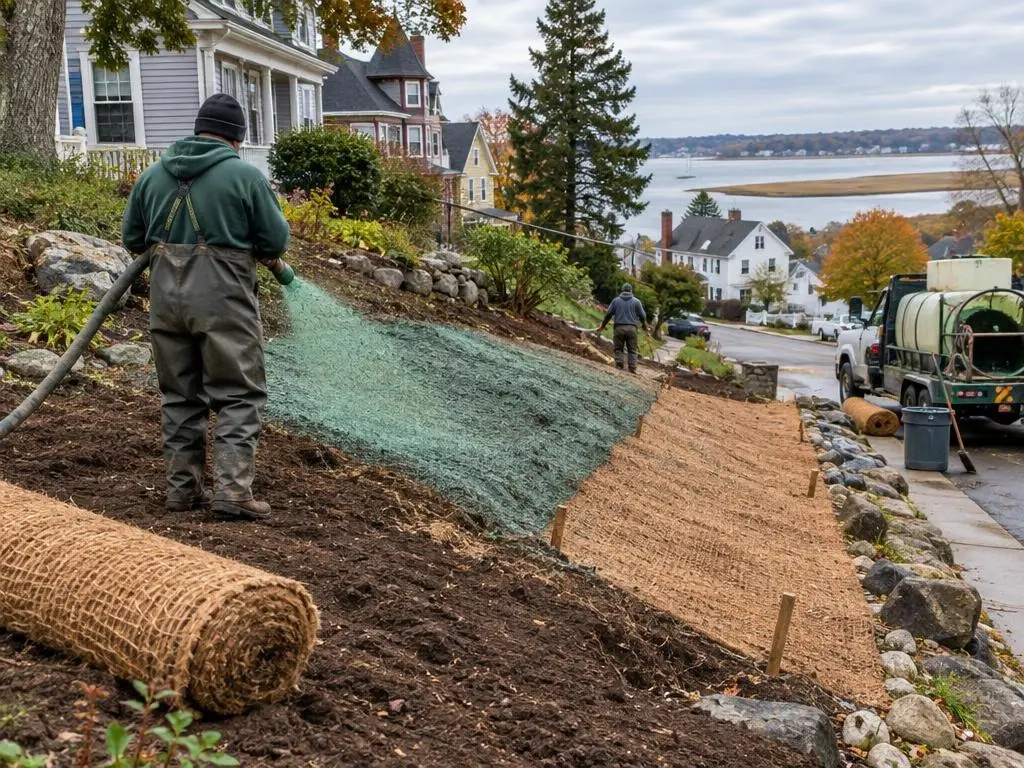
Bonded fiber matrix. On steeper, longer slopes, a bonded fiber matrix sprays on and dries into a continuous, porous crust that resists raindrop impact and runoff while seed germinates underneath. It is useful where a blanket would be hard to pin, such as rocky ground.
Erosion control blankets. Straw blankets, straw-coconut blends and coir blankets are rolled down the slope and stapled into the soil over seed. They are the strongest choice for steep banks and channels where water concentrates. Straw breaks down within a season or two; coir lasts longer for tougher spots.
Swales, ditches and channels
Where water flows rather than just falls, such as a roadside ditch, a swale along a property line or an outlet below a downspout, seed alone rarely survives. We shape the channel, line it with a blanket rated for flowing water, seed it, and make sure the outlet does not dump onto bare ground.
Slope stabilization for building work
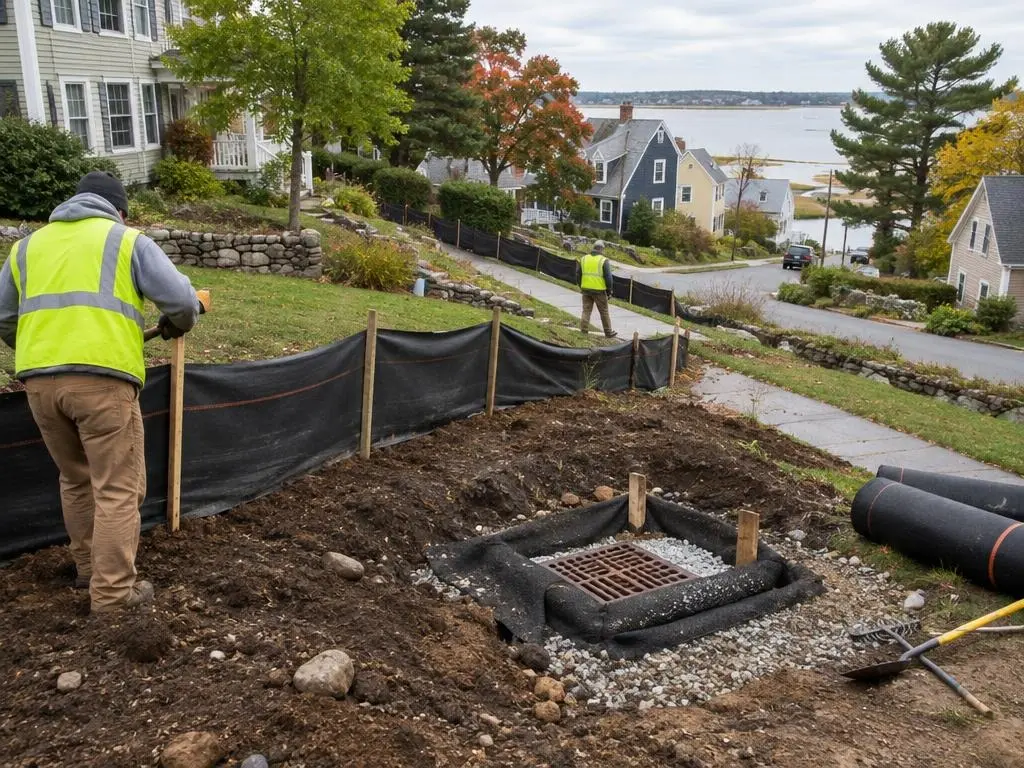
On construction sites, erosion control is part of the plan approved for the job. The federal rule behind every construction stormwater permit, as the EPA explains it, requires that bare, disturbed ground be stabilized right away once work on it pauses for longer than 14 days. We install the blankets and hydromulch called out on the plan and can work alongside your silt fence crew or install the fence ourselves.
When grass is not enough
Some banks are too steep, too shaded or too wet for turf. We will tell you if a slope needs a retaining wall, riprap or a planted groundcover instead of seed. We would rather say so at the estimate than seed something that will slide.
Call (401) 271-4843 or get a free estimate and we will walk the slope with you.
Erosion Control Options
What we use, from light cover to channel lining.
Hydromulch (hydro mulching)
Wood fiber mulch and tackifier at slope rates, sprayed with seed.
Bonded fiber matrix
Sprayed fiber that dries into a porous crust on steep or rocky slopes.
Straw erosion control blankets
Stapled straw blankets for moderate slopes; break down as grass establishes.
Straw-coir and coir blankets
Longer-lasting blankets for steep banks and flowing water.
Swale and ditch lining
Shaped channels lined, seeded and protected at the outlet.
Downspout and outlet protection
Stone or matting where concentrated water leaves a pipe.
Published Erosion Control Unit Prices
| Item | Published price |
|---|---|
| State DOT price list, January 2025: hydromulch of wood fiber, each 1,000 sq ft | $98 |
| Straw-coconut blanket (70/30), laid, per 1,000 sq ft (same list) | $468 |
| Coir blanket, laid, per 1,000 sq ft (same list) | $532 |
| Steep slope add-on to hydroseeding (HomeGuide) | $0.05 to $0.10 a sq ft |
| Bonded fiber matrix | Set once we measure the slope; no current published figure |
Cost-guide ranges. Your property gets its own written figure.
How We Stabilize a Slope
1. Look at the water
We trace the runoff: where it enters the slope and where it exits.
2. Choose the cover
Hydromulch, bonded fiber or blanket, picked by pitch, length and flow.
3. Prepare the surface
Rills filled, loose rock removed, top of slope shaped so water does not undercut it.
4. Seed and cover
Seed applied, then blankets stapled or mulch sprayed at slope rates.
5. Check after storms
We look at the slope after early heavy rain and repair any weak spots.
Why Choose Us for Slope & Erosion Control
The right material, not the most expensive
Hydromulch where it will hold, blankets only where they are needed.
Water first
We fix where runoff enters the slope, not just the bare spot.
Straight talk on steep banks
If seed is the wrong answer, we tell you before you pay for it.
Slope & Erosion Control Questions
Do I need a blanket or is hydroseed enough?
Short, moderate banks usually hold with a heavier hydromulch rate. Steep or long slopes, and anywhere water flows across the surface, generally need a blanket or bonded fiber matrix.
Will someone have to pull the blankets up later?
No. Straw and coir blankets rot away on the slope as the grass grows up through them. Some contain plastic netting; we can use natural-netting products near areas where wildlife or mowing are a concern.
What is a bonded fiber matrix?
It is sprayed mulch with a much stronger binder, so it cures into a single porous crust over the soil. It protects seed on steep ground where a blanket is hard to install.
Can you fix a bank that has already washed out?
Yes. We fill the gullies, regrade the face, deal with the water source, and then seed and cover it.

Slope & Erosion Control Service Areas
- Hydroseeding in Providence, RI
- Hydroseeding in Cranston, RI
- Hydroseeding in Warwick, RI
- Hydroseeding in East Providence, RI
- Hydroseeding in Pawtucket, RI
- Hydroseeding in Johnston, RI
- Hydroseeding in North Providence, RI
- Hydroseeding in Smithfield, RI
- Hydroseeding in Lincoln, RI
- Hydroseeding in Cumberland, RI
- Hydroseeding in Barrington, RI
- Hydroseeding in Bristol, RI
- Hydroseeding in Warren, RI
- Hydroseeding in East Greenwich, RI
- Hydroseeding in North Kingstown, RI
- Hydroseeding in Coventry, RI
- Hydroseeding in West Warwick, RI
- Hydroseeding in Scituate, RI
- Hydroseeding in Attleboro, MA
- Hydroseeding in Seekonk, MA
- Hydroseeding in Rehoboth, MA
- Hydroseeding in North Attleborough, MA
- Hydroseeding in Swansea, MA
Get a Slope & Erosion Control Estimate
Show us the bank and we will recommend the lightest treatment that will hold.